
The Board Approved a Presentation, Not a Decision
When AI makes every deck look flawless, the four questions that separate a decision from an approved presentation, and what happens eighteen months later if nobody asks them

TL;DR: I’ve sat through enough board decks to notice something shifting: the polish is no longer proof of the thinking behind it. This article comes out of a pattern I have been increasingly seeing, where a clean, AI-assisted case gets the same unanimous nod a rigorously stress-tested one used to earn. So I wrote down the four moves I actually use, during the meeting, to find out what’s underneath the finish before it hardens into an unrevisited assumption.

Mid-Meeting: The Deck Is Flawless
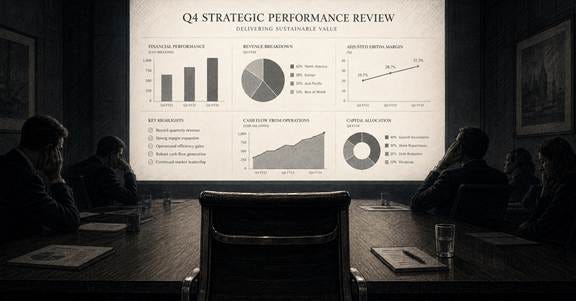
You are twenty minutes into the board deck and every slide lands.
The market sizing is clean. The growth case builds logically, slide to slide, no gaps you can put your finger on. The competitive analysis anticipates the objection you were about to raise and answers it before you open your mouth. Even the transitions feel considered, like someone tested the order three different ways before landing on this one.
Heads around the table are nodding. Not the polite nod, the real one. Someone across from you has stopped taking notes, which usually means they’ve already decided.
You feel it too, the pull toward yes. Not because you’ve verified the acquisition case, but because nothing in front of you has given you a reason to doubt it. The deck doesn’t just present the case. It preempts your skepticism, slide by slide, before you’ve had a chance to form it.
This is the moment. Not the vote. Not the debrief afterward. Right now, mid-meeting, with the presenter’s cursor still moving and the room’s momentum building toward approval.
You have a question. It’s not a big one. It’s the kind of question that used to feel almost rude to ask when a deck was this tight, because asking it implies the polish might be hiding something.
You almost let it go. Everything looks finished. Who are you to slow this down?
What Changed: Polish Stopped Meaning Anything
Here’s what changed.
For most of my career, polish was a proxy. A clean deck meant someone had spent real hours on it. Real hours meant someone had thought it through, stress tested the numbers, argued with a colleague about the framing. Polish signaled effort. Effort signaled thinking. That chain was never perfect, but it held well enough that experienced leaders leaned on it without noticing.
AI severed that chain. Finish quality is now free and instant. A junior analyst with no domain experience can produce a market sizing slide, a competitive matrix, and a growth narrative that looks indistinguishable from something a seasoned team built over three weeks. The polish still shows up. The thinking behind it is now optional.
Recent behavioral research has put a number on what that does to us. When people worked alongside AI-generated analysis, researchers found a large drop in scrutiny, sometimes called cognitive surrender, with a sizable measured effect. That’s not a marginal shift. That’s a strong, reliable pattern of people checking less and trusting more, even when the output was wrong.
Translate that into the boardroom you just sat in. The nodding, the person who stopped taking notes, the pull you felt toward yes before you’d verified anything. That’s cognitive surrender showing up in real time. Not because the room got lazier. Because the deck did exactly what polished decks have always done, and your instincts hadn’t caught up to the fact that polish no longer costs anything to produce.
Here’s the thesis I keep landing on with clients: judgment is now the only scarce resource in the building. Everything else, the formatting, the modeling, the narrative arc, can be generated in minutes. What can’t be generated is the discipline to ask the question the deck was built to make you forget to ask.
Move One: Ask What Was Cut, Not What’s Shown
Every polished case is really a set of choices about what got left out. Someone, or something, decided which scenarios made the deck and which didn’t. That decision is where the judgment lives, and it’s exactly what a clean set of slides won’t show you.
I’ve noticed AI-generated decks are especially good at smoothing over the scenarios that complicate the story. The model optimizes for a coherent narrative. Coherent narratives don’t dwell on the messy edge cases. So the growth story looks clean because the slide that would show customer concentration risk, or the one that would flag an integration timeline nobody’s actually validated, never made it into the deck at all.
I sat through a deal review a while back where the synergy case looked airtight. Revenue upside, cost savings, a clean three-year path. What wasn’t in the deck was the assumption that two overlapping ERP systems would integrate in nine months. Nobody had asked. It surfaced only when I asked a version of this question, and the answer was that the timeline had been dropped because it complicated the narrative, not because anyone had tested it.
So now I ask a simple question early in the meeting: What did we decide not to include, and who made that call?
That question does something a polish check can’t. It doesn’t ask whether the work is good. It asks who exercised judgment about what mattered enough to show me. If the honest answer is that nothing was cut, I’m suspicious. Real analysis always has trade-offs, edge cases, scenarios that didn’t make the cut because they were inconvenient. Someone made that call. My job is to find out who, and why.
Move Two: Ask Who Owns the Claim, Not Who Built the Slide
Once you know what was cut, the next question is who stands behind what’s left.
Here’s the distinction that matters now. AI can produce the slide. It can build the model, run the sensitivity analysis, and format the appendix better than most analysts I’ve worked with. What AI cannot do is stand behind the number when it’s wrong. It has no name to put on the line, no bonus at risk, no conversation with the board a year later when the assumption didn’t hold.
So in the room, I ask a direct question: “Whose name is on this assumption if it’s wrong in a year?”
I ask it plainly, not as a gotcha. And I watch what happens next.
Sometimes I get a confident answer. Someone owns it, has thought about the downside, and can tell me what they’d do if the number came in low. That’s a good sign. It tells me a real person did the thinking, not just the formatting.
But sometimes, I get a pause. Or a glance around the table. Or someone says, “That came out of the model” or “the team pulled that together,” which is a polite way of saying nobody owns it.
That pause is the answer. It tells you the number was produced, not owned. And a number nobody owns is a number nobody has actually pressure-tested against reality.
This move does one specific thing: it separates accountability from authorship. AI can author almost anything now. Accountability still has to sit with a person, in a role, with consequences attached. My job as a leader is to find out fast who that person is, before the deal closes and not after it goes sideways.
Move Three: Find the One Number Nobody Can Defend Off-Script
Every case has a load-bearing number. The margin assumption. The churn rate. The synergy estimate that makes the whole deal math work. Find it. Then close the laptop.
I mean that literally. I ask the presenter to set the slide aside and defend the number from memory. No deck, no notes, no scrolling back to the appendix. Just: “Walk me through how you got to that number.”
This single move tells me more than the previous forty minutes combined. If someone reasoned through the number, they can walk me through the logic in plain language. They can tell me what would have to be true for it to hold, and what would break it. If they inherited the number from a model output, the answer falls apart fast. They reach for the slide. They start talking about the tool that generated it instead of the reasoning behind it.
Here’s what worries me about this moment more than any single bad number. Research on human trust in algorithmic outputs points to a pattern I now watch for constantly: confidence rises the more polished and complete a generated output looks, even when the underlying number is wrong. The finish reads as truth. That’s the trap. A clean chart with a tight confidence interval feels more credible than a messy one, regardless of what’s actually underneath it.
So off-script defense is the fastest test I know for substance beneath finish. It cannot be prepared for the way a slide can. It exposes whether a team reasoned or simply reproduced.
If nobody at the table can defend the number without the deck in front of them, I’ve learned something important. Not that the number is wrong. That nobody has actually checked.
Move Four: Ask the Naive Question the Room Is Too Polished to Ask
Polished rooms punish simple questions. Ask something basic and you can feel the temperature drop. Eyes flick around the table. Someone half smiles, like you missed a memo everyone else got. The unspoken rule is that simple questions signal you weren’t paying attention, or worse, that you don’t belong at this level of the conversation.
That rule is exactly backward. The naive question is usually the load-bearing one.
I was in a deal review years ago where the case for an acquisition had been through three rounds of polish. Every objection had an answer. Every slide had a footnote. I asked one question: “Why do we believe this will work?” Not the synergy math. Not the integration timeline. Just that.
The room went quiet for a beat too long. Then the honest answer came out sideways: “Because the last two deals like this worked.” That was it. That was the whole foundation. Nobody had actually asked whether this deal shared the conditions that made the other two succeed. The polish had been covering an assumption, not a case.
Here’s the job as the senior person in the room. You give permission for that question to exist. If you don’t ask it, nobody junior will risk looking unsophisticated by asking it themselves. Research on psychological safety makes this point plainly: teams don’t withhold concerns because they lack them. They withhold them because the cost of raising them feels higher than the cost of staying quiet.
This move protects the group from its own polish. A team that has rehearsed its answers can still be wrong about its question. Someone has to be willing to sound simple long enough to find out. Sometimes it pays to be the “dumbest” person in the room.
The Cost of Skipping It
The cost of skipping these four moves doesn’t show up in the meeting. It shows up eighteen months later, and by then it has a price tag.
Industry research has tracked something like this pattern across private equity portfolio companies for years, and the finding seems fairly consistent. Deals that get unanimous approval at close, the kind where every board member nods and the case looks airtight, tend to run into trouble around the eighteen-month mark. Often it isn’t that the market shifted in some unforeseeable way. It’s that the expectations set at close were never really revisited. The board approved a story, and that story probably needed to be checked against reality as reality changed.
That’s not a market problem. That’s a governance failure. And it’s measurable, which means it’s not a hypothetical risk you can wave off as the cost of doing business.
Here’s the direct line to where we started. A polished, AI-assisted case gets the same unanimous nod, for the same reason. The model is confident. The narrative is clean. Nobody asked what was cut, who owns the underlying claim, which number would fold under a real question, or the naive question that would have exposed the load-bearing assumption. The board didn’t approve a decision. It approved a presentation.
Eighteen months later, someone will ask what happened. The honest answer is usually the same one I heard in that deal review: we believed it because the last few worked, or because the model said so, and nobody checked before we signed off.
That’s the cost. Not a bad quarter. A pattern of approvals that were never actually decisions, just agreements to trust the polish.
Judgment Is the Scarce Resource Now
Here’s the hypothesis I started with, and I still believe it. When output quality is free, when the deck, the model, and the narrative all come out polished by default, judgment becomes the only scarce thing left in the room.
AI can produce confidence. It cannot produce judgment. Those are not the same thing, and mistaking one for the other is how eighteen-month failures get born at the eighteen-day approval meeting.
This is what I mean when I talk about leading with both. Heart enough to ask the question twice, even when the room wants to move on. Head disciplined enough to know which question actually matters, and to ask it before the story hardens into fact.
The four moves I’ve walked through are not about doubting your team or slowing down good work. They are about staying the person in the room who checks what’s underneath the polish before it becomes an unrevisited assumption.
The leaders who get exposed over the next five years will not be the ones who trusted AI too much. They will be the ones who stopped asking what’s underneath it.
That’s the job now. Not resisting the tools. Staying the one who still asks.